
2- Origins of the Faith: From Solomon to the Nine Saints
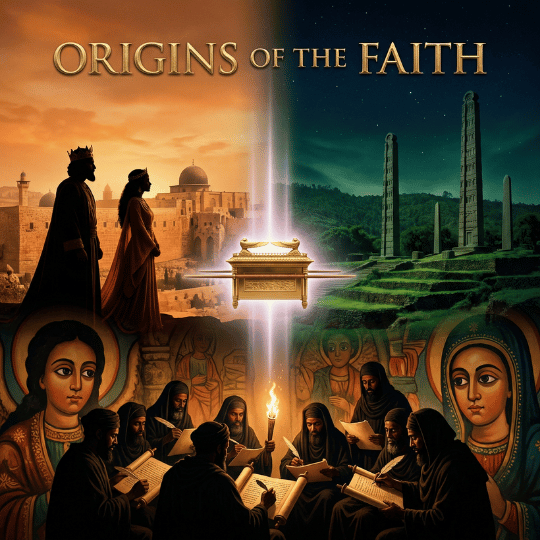
Origins of the Faith: From Solomon to the Nine Saints To open the Ethiopian Bible is to step into a stream of history that flows from a different source than the rest of the Christian world. While Western Christianity traces its textual lineage through the Latin Vulgate and the Greek Septuagint of the Mediterranean basin, the Ethiopian Orthodox Tewahedo Church (EOTC) claims a heritage that is distinctly “Judeo-Christian” in the most literal sense. It is a tradition that asserts a spiritual genealogy stretching back three thousand years, fusing the bloodline of King Solomon with the theology of the Apostles. Understanding the Ethiopian Bible—and why it contains books found nowhere else—requires us to navigate a history that is part documented fact, part sacred legend, and entirely foundational to the Ethiopian worldview. This article explores the origins of this faith, tracing the arc from the legendary visit of the Queen of Sheba to the scholarly monastic revolution of the “Nine Saints.” Part I: The Solomonic Foundation and the “New Israel” The distinctiveness of the Ethiopian biblical canon is rooted in the conviction that Ethiopia is not merely a Christian nation converted by missionaries, but the “New Zion.” This belief is codified in the Kebra Nagast (The Glory of the Kings), a 14th-century national epic that serves as a repository of Ethiopian religious feelings and identity. The Queen of Sheba and Menelik I The narrative begins with the biblical account of the Queen of Sheba’s visit to King Solomon (1 Kings 10). In the Western tradition, this is a story of diplomatic curiosity. In the Ethiopian tradition, expanded upon in the Kebra Nagast, it is the moment of national conception. The text describes how Makeda (the Ethiopian name for the Queen) visited Jerusalem to partake of Solomon’s wisdom. From their union, a son was born: Menelik I. According to the tradition, Menelik I later visited his father in Jerusalem. Upon his return to Ethiopia, he was accompanied by the firstborn sons of Israel’s high priests and, crucially, they brought with them the Ark of the Covenant (Tabot). This transfer signifies a theological transference: the favor of God moved from Jerusalem to Aksum. A “Judeo-Christian” Reality This Solomonic lineage is not treated as mere myth by the EOTC; it is the theological justification for the church’s unique “Judeo-Christian” practices. The Ethiopian Church is often described as preserving a form of Christianity that never rejected its Semitic roots. This is evident in practices that mirror the Old Testament more closely than any other Christian tradition: The Tabot: Every Ethiopian church must contain a replica of the Ark of the Covenant (Tabot) to be consecrated. Without this link to the Solomonic heritage, a building is just a building. Sabbath Observance: Uniquely, the church observes both the Saturday Sabbath (the Sabbath of the Jews) and Sunday (the Lord’s Day). Dietary Laws: The faithful observe dietary restrictions similar to the Levitical laws, avoiding pork and other “unclean” foods. Circumcision: Male circumcision is practiced on the eighth day, strictly adhering to the Abrahamic covenant. Scholars like Mikre Sellassie argue that these deep-rooted practices suggest that forms of Judaism or Hebraic religion were practiced in Ethiopia long before the arrival of Christianity. This creates a biblical context where the “Old Testament” was not a foreign text introduced by Christians, but a native history. When the gospel arrived, it was viewed as the completion of a faith already present, not the replacement of a pagan void. Part II: The Apostolic Interlude and the Eunuch If the Solomonic line provided the soil, the New Testament provided the seed. The EOTC points to the narrative in Acts 8:27-40 as the moment of its Christian birth. The text describes an “Ethiopian eunuch,” a high official of Queen Candace, who had traveled to Jerusalem to worship. This encounter is profound. The official was reading the prophet Isaiah—specifically the Septuagint (Greek) version—when Philip the Evangelist approached him. This confirms that Jewish scriptures were already accessible and revered by Ethiopian nobility in the first century. The eunuch’s conversion and baptism mark the first time the Gospel entered the African interior. While some modern historians argue that the “Ethiopia” of Acts refers to the Kingdom of Meroë (modern Sudan) rather than Aksum, the Ethiopian tradition firmly claims this figure as the first fruit of their church. This narrative reinforces the idea that Christianity in Ethiopia was an apostolic movement, accepted by a people who were already “stretching out their hands to God” (Psalm 68:31), a verse frequently cited to validate Ethiopia’s special status. Part III: The Official Conversion—Frumentius and Ezana While individual believers may have existed since the first century, the structural birth of the Ethiopian Church occurred in the 4th century. This era moved the faith from the roadside encounter of a eunuch to the throne room of an empire. The Shipwreck Bishop The historical account, corroborated by the Roman historian Rufinus, tells of two Tyrian Christian brothers, Frumentius and Aedesius, who were shipwrecked or captured on the Red Sea coast. Taken as slaves to the royal court of Aksum, their wisdom and integrity earned them positions of high trust. Frumentius eventually became the tutor to the young heir to the throne, King Ezana. When Ezana ascended to power, he did not just adopt Christianity personally; he made it the state religion. This occurred roughly around the same time Constantine was legalizing Christianity in Rome, making Aksum one of the first Christian empires in the world. The Link to Alexandria Frumentius did not simply declare himself a bishop. He traveled to Alexandria to ask the Patriarch, St. Athanasius, to send a bishop to Ethiopia. Athanasius, recognizing Frumentius’s role, consecrated him as the first Bishop of Aksum, giving him the title Abuna Selama (Father of Peace) or Kesate Berhan (Revealer of Light). This event established a juridical and spiritual bond with the Coptic Church of Egypt that would last for sixteen hundred years. It also cemented the EOTC’s theological alignment
1- The Canon Enigma: Deciphering the 81 (or 88) Books of the Ethiopian Bible
The Canon Enigma: Deciphering the 81 (or 88) Books of the Ethiopian Bible In the landscape of global Christianity, few topics elicit as much fascination and confusion as the biblical canon of the Ethiopian Orthodox Tewahedo Church (EOTC). For the Western believer, accustomed to the tidy boundaries of the 66-book Protestant Bible or the 73-book Catholic canon, the Ethiopian tradition presents a staggering abundance of sacred literature. A quick search online today often leads to titles boasting “The Ethiopian Bible: 88 Books,” yet if you were to ask a learned debtera (a lay cantor and scribe) in Axum or Lalibela, they would steadfastly affirm that the Holy Scriptures consist of 81 books. Where does this discrepancy lie? Is it 81? Is it 88? Or is the very question of a “fixed number” imposing a Western category on an African tradition that operates by a different set of theological rules? This article aims to be the definitive guide to understanding the structure of the Ethiopian biblical canon. We will move beyond the superficial listicles found on the internet and dive deep into the philological and historical reality of the text. We will explore the dual systems of the “Broader” and “Narrower” canons, the specific texts that make up these lists, and the profound theological implications of a church that views the boundaries of Scripture as a living, breathing horizon rather than a closed fortress. The Concept of Canon: Rule of Faith vs. List of Books To understand the number of books in the Ethiopian Bible, one must first unlearn the Western definition of “canon.” In the history of the European church, particularly after the Council of Trent and the Protestant Reformation, the “canon” became a rigid list of inclusion and exclusion. A book was either inspired and authoritative, or it was apocryphal and rejected. The line was drawn in ink, and to cross it was heresy. In the Ethiopian Orthodox tradition, the concept of canon is far more fluid and functional. The Ge’ez term often used is Qanona, derived from the Greek kanon, but its application is closer to the early Church’s understanding of a “rule of faith” or a “measuring stick” for truth, rather than a strictly closed bibliographic index. As the scholar Bruk Ayele Asale notes in his research on the subject, the EOTC canon is “neither strictly closed nor open.” It is a corpus of literature that has been received, preserved, and used for liturgy and doctrine over 1,600 years. The number 81 is sacrosanct in Ethiopian tradition. It is a symbolic number representing fullness and apostolic authority. However, which books constitute that number has varied over centuries, depending on whether one is consulting a manuscript from the 15th century, a printed Bible from the 20th century, or the legal code known as the Fetha Nagast. The confusion regarding the “88 books” often arises in modern English compilations which physically print every single distinct text available, ignoring the Church’s traditional method of grouping multiple texts under a single title to maintain the sacred count of 81. To truly master this topic, we must dissect the two primary ways the Church counts its books: the Narrower Canon (Nisus) and the Broader Canon (Abiy). The Narrower Canon: The Standard for Printing When you purchase a printed Amharic or Ge’ez Bible in Addis Ababa today, you are likely holding the Narrower Canon. This is the list most commonly used for mass production and personal reading. Curiously, even this “narrow” list contains far more books than Western Bibles. The Narrower Canon achieves the count of 81 books through the following calculation: 54 Old Testament books + 27 New Testament books = 81. The Old Testament of the Narrower Canon (54 Books) How does the Ethiopian Old Testament reach 54 books when the standard Septuagint count is usually lower? The answer lies in the unique Ethiopian practice of splitting and grouping books. The Octateuch (8 Books): This includes the standard Pentateuch (Genesis, Exodus, Leviticus, Numbers, Deuteronomy) plus Joshua, Judges, and Ruth. This grouping is standard across many Orthodox traditions. The Historical Books: The books of Samuel and Kings are often counted as one book each in ancient manuscripts, but in the Narrower Canon count, they are separated: 1 Samuel, 2 Samuel, 1 Kings, and 2 Kings. Similarly, Chronicles is split into 1 and 2 Chronicles. The Unique Additions: Here is where the Ethiopian tradition diverges sharply. The Narrower Canon includes: Jubilees (Metsihafe Kufale): Known as “The Little Genesis,” this book offers a retelling of Genesis with a specific chronological framework based on 49-year cycles (Jubilees). It is fully canonical. Enoch (Metsihafe Henok): This is 1 Enoch, the apocalyptic masterpiece preserved in its entirety only in Ge’ez. It is not an appendix; it is a major prophet. The Books of Ezra: The classification of Ezra is complex. The canon includes Ezra Sutuel (often known as 4 Ezra or the Ezra Apocalypse in the West) and Second Ezra (which corresponds to the Greek Esdras or the Latin 3 Esdras). These are often counted separately to boost the number. The Maccabees (Meqabyan): Crucially, the Ethiopian books of Maccabees are not the same as the Roman Catholic 1 and 2 Maccabees. They are distinct compositions (1, 2, and 3 Meqabyan) that focus on different martyrs and theological themes, specifically the martyrdom of a Benjaminite named Meqabis. In the Narrower count, these are often listed as three separate books. The Wisdom Literature Split: To reach the high number of 54, the Church traditionally splits the Book of Proverbs into two distinct books: Messale (Proverbs chapters 1–24) Tegsats (Reproof, comprising Proverbs chapters 25–31) Furthermore, distinct books like Metsihafe Tibeb (Wisdom of Solomon) and Sirach (Ecclesiasticus) are included. Joseph ben Gurion (Yosëf wäldä koryon): This is a history of the Jews, often called Josippon or Pseudo-Josephus. In the Narrower Canon, this is counted as a canonical book of the Old Testament, fulfilling the role of historical chronicle for the later Second Temple period. By treating the