
12- A Gift to the World: The Ethiopian Bible in Ecumenical Dialogue
A Gift to the World: The Ethiopian Bible in Ecumenical Dialogue For nearly 1,500 years, the Ethiopian Orthodox Tewahedo Church (EOTC) stood as a solitary island of Christianity in the Horn of Africa. Surrounded by Islamic powers and separated from the European West by geography and theology, it developed in isolation. This isolation was its greatest strength. While the churches of Rome, Constantinople, and later the Protestant West were busy refining their canons—often by pruning and excluding—the Ethiopian Church was busy preserving. Today, as the global Church seeks deeper unity and a richer understanding of its own origins, the Ethiopian Bible has emerged from the mist of legend to become a subject of intense interest. It is no longer viewed merely as an “anomaly” with too many books. It is increasingly recognized as a Time Capsule of the early Church—a repository of ancient Jewish-Christian literature that the rest of the world lost, but now desperately needs. In this final article, we will explore the value of the Ethiopian Bible in the modern world. We will discuss how its unique texts (like 1 Enoch) are revolutionizing New Testament scholarship, how its “broader” concept of canon challenges Western rigidity, and how this ancient African tradition serves as a bridge between the Semitic past and the global Christian future. Part I: The Recovery of “Lost” Contexts For centuries, Western biblical scholars struggled with certain passages in the New Testament. When the Epistle of Jude quotes a prophecy by Enoch (Jude 14-15), or when 2 Peter speaks of angels cast down to “Tartarus,” they were often working in the dark. The source texts were lost to the West. The re-introduction of the Ethiopian Bible to global scholarship changed everything. By preserving 1 Enoch and Jubilees in their entirety, Ethiopia provided the “missing link” for understanding Second Temple Judaism (the period between the Old and New Testaments). The “Son of Man” As we explored in earlier articles, the Ethiopian text of 1 Enoch contains the “Book of Parables,” which presents the “Son of Man” as a pre-existent, heavenly judge. Modern scholars now acknowledge that this Ethiopian text provides the most immediate theological background for how Jesus used the title “Son of Man” in the Gospels. Without the Ethiopian Bible, the historical context of Christ’s self-designation remains incomplete. The Dead Sea Scrolls Connection When the Dead Sea Scrolls were discovered in Qumran in the 1940s and 50s, fragments of Enoch and Jubilees were found in Aramaic and Hebrew. To the amazement of scholars, they matched the Ge’ez translations preserved in Ethiopia with high fidelity. This vindicated the Ethiopian tradition. It proved that the EOTC had not “invented” these books, but had faithfully guarded the heritage of the Essenes and the early Christians for two millennia. Ethiopia was right all along. Part II: Canon as a “Spectrum” vs. a “List” The most significant contribution the EOTC can make to ecumenical dialogue lies in its very concept of “Canon.” In the West (Catholic and Protestant), the Canon is defined by exclusion. A book is either “in” (inspired/infallible) or “out” (apocryphal/fallible). The line is sharp and rigid. In the Ethiopian tradition, the Canon is defined by gradation. As we saw with the “Broader” and “Narrower” lists, the canon is a flexible library. The Holy of Holies: The Gospels and the core Octateuch. The Holy Place: The rest of the 81 books (including Enoch and Jubilees). The Outer Court: The “Books of the Monks” and early Fathers (Filaqseyus, Aragawi Menfasawi) which are read in church but are not scripture. This fluid model reminds the global Church that the “Word of God” is a living river, not a static list. It allows for a reverence of tradition that does not require every single text to carry the same dogmatic weight. This “Ethiopian Model” helps explain how the early Church actually functioned before the rigid councils of the 4th century—reading widely, discerning spiritually, and finding Christ in a multitude of witnesses. Part III: The “Third Lung” of Christianity Pope John Paul II famously said that the Church must breathe with “two lungs”—the East (Byzantine/Slavic) and the West (Latin/Protestant). However, scholars today argue that there is a Third Lung: the Oriental Orthodox tradition, specifically the Semitic/African branch preserved in Ethiopia. Western Christianity was heavily influenced by Greek philosophy (Platonism/Aristotelianism) and Roman law. Ethiopian Christianity, however, bypassed the Greco-Roman filter. It remained deeply Semitic. It kept the Saturday Sabbath. It maintained the dietary laws. It preserved a functional “Temple” theology with the Tabot. This makes the Ethiopian Bible a bridge to the Jewish roots of the faith. For a modern Christian trying to understand the Jewishness of Jesus, the Ethiopian Church offers a living laboratory. It shows us what a “non-Gentilized” Christianity looks like. It reminds the world that Christianity is not a European religion, but a Middle Eastern and African faith that has its own indigenous intellectual history. Part IV: A Theology of Preservation, Not Innovation In ecumenical settings, modern churches often argue about “innovation”—new doctrines, new moralities, new liturgies. The Ethiopian witness offers a powerful counter-weight: the Theology of Preservation. The EOTC calls itself Tewahedo (Unified) and Qidist (Holy), but its ethos is deeply conservative in the literal sense: to conserve. They conserved the Book of Enoch when the Greeks mocked it. They conserved the Ark of the Covenant tradition when others spiritualized it. They conserved the ancient music of St. Yared (6th century) without alteration. This witness challenges the modern church to stop asking “What is new?” and start asking “What have we lost?” The Ethiopian Bible stands as a monument to the idea that the Church’s primary duty is to be a faithful steward of the mysteries entrusted to it, even when the rest of the world moves on. Part V: Unity in Diversity Finally, the 81-book canon teaches the global church a lesson in Unity in Diversity. For centuries, outsiders accused Ethiopia of being “heretical” or “judaizing” because its Bible was
11- Visualizing the Word: The Art of Ethiopian Manuscripts and Iconography
Visualizing the Word: The Art of Ethiopian Manuscripts and Iconography In the Ethiopian Orthodox tradition, the Bible is never merely a text to be analyzed; it is a holy object to be venerated. While the modern West consumes Scripture primarily through mass-produced paperbacks or digital screens, the Ethiopian experience of the Word of God is inextricably bound to the Manuscript (Brana). To hold an Ethiopian Bible is to hold the skin of a sacrificial animal, prepared with prayer, inscribed with ink made from local plants and soot, and illuminated with colors derived from the earth itself. It is a sensory encounter. The smell of the vellum, the texture of the pages, and the vibrant gaze of the painted saints all participate in the revelation. This article explores the “Art of Scripture” in Ethiopia. We will journey into the scriptoriums of the monasteries where the ancient craft of bookmaking has survived unchanged for 1,600 years. We will examine the oldest illustrated Gospels in the world (the Garima Gospels), decode the unique theological language of Ethiopian iconography—where “eyes” are windows to the soul—and see how books like 1 Enoch have shaped the visual imagination of a nation. Part I: The Living Tradition of the Scribe In most of Christendom, the invention of the printing press in the 15th century ended the era of the scribe. In Ethiopia, the printing press arrived, but the scribe never left. The production of handwritten manuscripts on parchment remains a living, breathing craft, considered superior to printed books for liturgical use because the labor involved is itself an act of devotion. The Preparation of the Parchment (Brana) The process begins not with paper, but with a goat or sheep. The animal must be slaughtered according to the proper rites (In the name of the Father, the Son, and the Holy Spirit). The skin is then soaked in water, stretched on a frame, and scraped with a specialized tool to remove hair and flesh. It is sanded with pumice until it is smooth and white. This material, known as Vellum or Parchment, is incredibly durable. While paper yellows and crumbles after a few centuries, Ethiopian vellum manuscripts from the 14th and 15th centuries often look as if they were written yesterday. The Pen and the Ink The scribe (Kum-Tsishuf or Debtera) fashions his pen (Qalam) from river reeds, cutting different nibs for the thick, bold letters of the Ge’ez script. The ink (Meqe) is a complex alchemical mixture. Black ink is made from soot, gum arabic, and water; red ink, used for the names of God and saints (rubrication), is often made from plants or minerals. Writing is a spiritual discipline. The scribe must be ritually clean. He often fasts while working. Every time he writes the name of God, it is a prayer. This imbues the physical object with a sanctity that a factory-printed book can never possess. Part II: The Garima Gospels—Anchoring History For decades, art historians believed that the illuminated manuscripts of Ethiopia were late developments, perhaps influencing European art in the Middle Ages but not dating back to antiquity. This view was shattered by the carbon dating of the Garima Gospels. Housed in the remote Abba Garima Monastery in Tigray, these two gospel books contain stunning, full-page illuminations of the Evangelists and architectural canon tables. Recent radiocarbon analysis dated them between 330 and 650 AD. This makes them the earliest illustrated Christian manuscripts in the world, predating the famous Celtic Book of Kells by centuries. They prove that the Ethiopian “Art of Scripture” is not a medieval invention but an ancient apostolic heritage, contemporary with the Nine Saints themselves. Part III: The Theology of the Eye When you open an illuminated Ethiopian manuscript, the first thing that strikes you is the eyes. The figures—whether Christ, Mary, or the Apostles—are depicted with large, exaggerated, almond-shaped eyes that stare directly at the viewer. Frontality vs. Profile This is not a stylistic accident; it is a theological code. Full Face (Frontal): Holy figures (Saints, Angels, Christ) are always depicted facing forward, with both eyes visible. This represents spiritual wholeness and the ability to “see” the viewer with compassion and truth. It signifies that they have nothing to hide and are in direct communion with God. Profile (Side View): Evil figures (Judas Iscariot, demons, Roman soldiers crucifying Christ) are almost always depicted in profile, showing only one eye. This represents spiritual incompleteness, duplicity, and a turning away from the truth. This visual language allows an illiterate believer to immediately read the moral status of a character in a Bible story. If you see one eye, beware; if you see two, behold. Part IV: Illustrating the “Enochic” Universe The unique contents of the Ethiopian canon have given birth to a unique iconography found nowhere else in Christian art. Because the Ethiopian artist has access to 1 Enoch, Jubilees, and the Apocalypse of Peter (in the Clementine books), his depiction of the invisible world is far more detailed. The Four Living Creatures Drawing on 1 Enoch and Ezekiel, Ethiopian manuscripts teem with the Tetramorph—the Four Living Creatures (Man, Lion, Ox, Eagle). These are not just symbols of the Evangelists (as in the West); they are literal angelic beings (Kirubel) supporting the Throne of God. They are often depicted covered in eyes, representing their omniscience and vigilance as the “Watchers” who remained faithful. The Twenty-Four Heavenly Priests Often depicted in the margins of manuscripts or on church ceilings are the Twenty-Four Elders of Revelation (often identified with the angelic priesthood). They are shown holding censers and sistrums (tsanatsil), dressed in the vestments of Ethiopian priests. This reinforces the idea that the earthly liturgy is a mirror of the heavenly one. The Head of Days Influenced by the descriptions in 1 Enoch of the “Head of Days” (the Ancient of Days) with hair like white wool, Ethiopian art often depicts the Father and the Son with distinct but unified iconography, sometimes
10- Tewahedo: The Harmony of Jewish Practice and Christian Faith
Tewahedo: The Harmony of Jewish Practice and Christian Faith To the modern Western Christian, the boundary between the “Old Testament” and the “New Testament” is often marked by a sharp cultural break. In the West, the Church moved from the Synagogue to the Basilica; it traded the Sabbath for the Lord’s Day, circumcision for baptism, and the dietary laws of Leviticus for the freedom of the Gentile mission. We are taught that the “Old” has passed away to make room for the “New.” However, if you enter the world of the Ethiopian Orthodox Tewahedo Church (EOTC), this line blurs into insignificance. Here, you find a Christianity that refuses to choose between Moses and Jesus. It is a faith where the faithful dance before the Ark of the Covenant, circumcise their sons on the eighth day, abstain from pork, and honor the Saturday Sabbath with the same fervor as the Sunday Resurrection. This is not—as early European missionaries erroneously claimed—a “Judaizing heresy.” Nor is it a syncretism of two different religions. It is a unique preservation of the earliest form of Apostolic Christianity, a faith that grew out of a Hebraic soil and never felt the need to sever its roots. The Ethiopian Bible, with its inclusion of Jubilees and the Didascalia, provides the legal and theological mandate for this way of life. In this article, we will explore the “Judeo-Christian” synthesis of Ethiopia. We will examine the scriptural basis for its unique practices—specifically the Sabbath, Circumcision, and Dietary Laws—and understand how the Ethiopian Bible creates a total way of life that honors the Law while celebrating the Grace of Christ. Part I: The Two Sabbaths (Sanbat) Perhaps the most visible and controversial difference between Ethiopian Orthodoxy and the rest of Christendom is the observance of the Sabbath. For most of Christian history, the Western Church (Catholic and Protestant) has argued that the Sunday “Lord’s Day” replaced the Jewish Saturday Sabbath. The Ethiopian Church, however, officially observes two Sabbaths: Qidamit Sanbat: The “First Sabbath” (Saturday). Sanbat Kristian: The “Christian Sabbath” (Sunday). The Authority of Jubilees The theological foundation for keeping the Saturday Sabbath is found in the Book of Jubilees (Metsihafe Kufale), which, as we have seen, is a canonical text in Ethiopia. Jubilees presents the Sabbath not merely as a temporary sign for the Jews, but as a cosmic reality. It states that the Sabbath was kept by the Angels of the Presence and the Angels of Sanctification in heaven long before man was created. “And we kept Sabbath in the heavens before it was made known to any flesh to keep Sabbath thereon on the earth.” (Jubilees 2:18, Source 87). If the Sabbath is an eternal, angelic practice, it cannot be abolished. The Book of Jubilees prescribes the death penalty for those who profane it, creating a sense of awe and severity around the day. The Didascalia’s Instruction This Old Testament view is harmonized with the New Testament through the Ethiopic Didascalia (Didesqelya). While some Western versions of the Apostolic Constitutions (on which the Didascalia is based) tend to minimize the Saturday Sabbath, the Ethiopian text explicitly commands the honor of both days. The Ethiopic Didascalia states: “We ought not to fast on the Sabbath, except on the one day (the Sabbath) of the Passion [Holy Saturday]; but the other Sabbaths let us honour because our Lord rested from all His work on the Sabbath day.” (Ethiopic Didascalia, Source 259). In Ethiopian practice, this means that Saturday is a day of solemn liturgy (the Qidase is celebrated), no heavy work is performed, and fasting is forbidden (except during Holy Week). Sunday is then celebrated as the day of Resurrection. This “double weekend” is not a burden to the Ethiopian believer but a double blessing—honoring God as Creator (Saturday) and as Redeemer (Sunday). Part II: Circumcision (Gizret) In the West, circumcision is a medical option; in Judaism, it is the sign of the Covenant. In Ethiopia, it is a religious obligation for Christians, performed strictly on the eighth day. This practice has puzzled outsiders for centuries. Did not St. Paul say, “Circumcision is nothing and uncircumcision is nothing” (1 Corinthians 7:19)? Why does an ancient Christian church insist on it? The Covenant of Abraham The Ethiopian rationale is deeply rooted in the Covenant of Abraham, which they believe was never revoked for the physical descendants of the faith. The Book of Jubilees again plays a critical role here. Jubilees 15 warns that anyone not circumcised on the eighth day “belongs not to the children of the covenant… but to the children of destruction”. “And do thou command the children of Israel and let them observe the sign of this covenant for their generations as an eternal ordinance, and they will not be rooted out of the land.” (Jubilees 15:28, Source 99). For the Ethiopian Church, Jesus Christ was circumcised on the eighth day (Luke 2:21). Since the faithful are called to imitate Christ, they too must undergo the sign of the covenant. It is not viewed as a means of salvation (which comes through Baptism), but as a mark of identity. It signifies membership in the community of the “New Israel.” The Relationship with Baptism Crucially, in the Ethiopian tradition, circumcision does not replace Baptism. Male children are circumcised on the 8th day and baptized on the 40th day. Female children are baptized on the 80th day. These timings—40 and 80 days—are derived directly from the Book of Jubilees (Chapter 3), which explains that Adam entered the Garden of Eden 40 days after his creation, and Eve entered 80 days after hers. “And for this reason the commandment is written on the heavenly tablets in regard to her that gives birth: ‘if she bears a male, she shall remain in her uncleanness seven days… and thirty and three days… But in the case of a female child… sixty-six days in the blood of her purification, and they will be in all eighty days.’
9- The Book of Enoch and the Ethiopian Calendar: Living in Sacred Time
The Book of Enoch and the Ethiopian Calendar: Living in Sacred Time If you fly into Addis Ababa from London or New York today, you do not just cross a geographical distance; you travel through time. Upon landing, you will discover that the year is not 2024, but 2016 (or 2017, depending on the month). You will find that there are not twelve months in the year, but thirteen. And if you ask a priest for the time, he might tell you it is “the third hour,” when your watch clearly reads 9:00 AM. For the casual tourist, these are quaint cultural quirks. But for the student of the Ethiopian Bible, these are profound theological statements. The unique Ethiopian calendar is not merely a different way of counting days; it is a liturgical fortress constructed from the blueprints found in the Book of Enoch (Metsihafe Henok) and the Book of Jubilees (Metsihafe Kufale). While the rest of the Christian world adopted the Gregorian calendar (a refinement of the Roman Julian system) or follows the lunar calculations for Easter, the Ethiopian Orthodox Tewahedo Church (EOTC) has remained faithful to a “Solar-Enochic” computation. They believe that time is not a blank container for human activity; it is a divine creation with a fixed structure, revealed by the Archangel Uriel to the prophet Enoch. To alter the calendar is to alter the very rhythm of worship ordained by God. In this article, we will explore the Astronomical Book of Enoch (1 Enoch 72–82), the warnings of Jubilees against the moon, and how these ancient texts govern the daily life, the feasts, and the “Sea of Calculation” (Bahere Hasab) of the Ethiopian Church. Part I: The Angel Uriel and the Heavenly Portals To understand the Ethiopian view of time, we must return to the text that Western canons discarded. The third section of 1 Enoch, known as the Astronomical Book, is entirely devoted to the movements of the heavenly bodies. It is scientific, precise, and mathematical. In the narrative, Enoch is guided by Archangel Uriel, who is described as the leader of the luminaries. Uriel does not just show Enoch the sun and moon; he shows him the Laws by which they move. The Mystery of the Gates The central mechanic of the Enochic universe is the system of “Portals” or “Gates” (Kwaw). Enoch describes seeing six portals in the east where the sun rises, and six portals in the west where it sets. “And this is the first law of the luminaries: the luminary the Sun has its rising in the eastern portals of the heaven, and its setting in the western portals of the heaven… In this way he rises in the first month in the great portal, which is the fourth.” (1 Enoch 72:2, 6). The text details how the sun moves through these gates month by month, changing the length of the day and night. For example, when the sun is in the fourth gate, the day and night are equal. As it moves to the fifth and sixth gates, the days lengthen. As it returns to the first, second, and third, the days shorten. This is not intended to be poetic metaphor; it is presented as revealed physics. For the Ethiopian tradition, the sun is obeying a command. It is “guided” by angels to ensure it enters the correct portal at the exact moment. This creates a universe that is strictly ordered, predictable, and obedient to God. The 364-Day Year The most critical revelation in this section is the length of the year. Uriel teaches Enoch a solar year of 364 days. The calculation is specific: The sun passes through the portals for 30 days each. 12 months x 30 days = 360 days. However, there are four intercalary days (days of separation) that belong to the four quarters of the year, usually associated with the equinoxes and solstices. Total: 360 + 4 = 364. Enoch emphasizes that these four days are distinct: “And the leaders of the heads of the thousands, who are placed over the whole creation and over all the stars, have also to do with the four intercalary days, being inseparable from their office… And owing to them men go wrong therein” (1 Enoch 75:1-2). This 364-day structure is the ancestor of the Ethiopian calendar. While the current Ethiopian calendar has adjusted to 365 days (to account for the true solar reality, adding a 5th or 6th day to the 13th month), it retains the rigid structure of Twelve Months of 30 Days. Unlike the Gregorian calendar, where months fluctuate between 28, 30, and 31 days arbitrarily, the Ethiopian months (Meskerem, Tikimt, Hidar, etc.) are perfectly symmetrical, preserving the Enochic ideal of divine order. Part II: The War Against the Moon (Jubilees) If Enoch provides the blueprint, the Book of Jubilees provides the polemic. Why is the Ethiopian Church so resistant to Western or Lunar calendars? Because Jubilees frames the lunar calendar not as an alternative option, but as a corruption. In Jubilees chapter 6, the author warns that forgetting the 364-day solar cycle will lead to spiritual chaos: “For there will be those who will assuredly make observations of the moon—how it disturbs the seasons and comes in from year to year ten days too soon. For this reason… they will confound all the days, the holy with the unclean, and the unclean day with the holy; for they will go wrong as to the months and sabbaths and feasts and jubilees.” This is a theological bombshell. If you use a lunar calendar (like the Jewish calendar or the Islamic calendar), your feasts drift. You might celebrate Passover on a day that is actually a common workday in the eyes of the angels. You might miss the Sabbath. For the Ethiopian Orthodox, Sacred Time requires synchronization with the angels. If the angels keep the Sabbath on the 7th day of a fixed solar cycle, humans must do the same.
8- Angelology and Demonology: The Invisible Influence
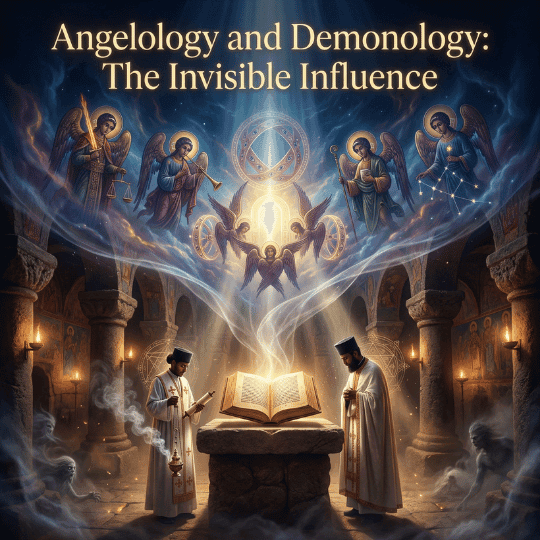
Angelology and Demonology: The Invisible Influence In the Western secular worldview, the “supernatural” is often viewed as a distant, abstract concept—something that interrupts the natural order only in rare miracles or metaphors. In the worldview of the Ethiopian Orthodox Tewahedo Church (EOTC), however, the wall between the visible and the invisible is paper-thin. The air is not empty; it is thick with traffic. To enter an Ethiopian church is to step into a court where the “Watcher Angels” are as real as the priest holding the censer. To fall ill in the Ethiopian highlands is often interpreted not merely as a biological failure, but as a skirmish in a cosmic war involving the spirits of ancient giants. This profound sensitivity to the spirit world is not superstition; it is a sophisticated theology rooted directly in the unique biblical canon we have been exploring. Because the Ethiopian Bible includes 1 Enoch, Jubilees, and the Sinodos, it possesses the most detailed “map” of the spirit world in all of Christendom. While other traditions may mention Michael and Gabriel, the Ethiopian tradition knows the names of the officers of the heavenly court, the geography of the abyss, and the legal history of the demons. In this article, we will explore this “Invisible Influence.” We will examine the complex hierarchy of the Angels, the terrifying origin of Demons, and the practical ways—from liturgy to the controversial work of the Debteras—that Ethiopian Christians navigate this perilous spiritual landscape. Part I: The Angelic Hierarchy—The Court of the Most High In Western Christianity, angels are often reduced to two-dimensional winged figures of comfort. In the Ethiopian tradition, drawing heavily from 1 Enoch and the Liturgy, angels are terrifying, majestic, and organized into a complex military and liturgical hierarchy. The Archangels: The Four and the Seven Central to this worldview are the Archangels. While the West typically focuses on Michael, Gabriel, and Raphael, the Ethiopian tradition, relying on 1 Enoch 40 and 20, identifies a more complete cabinet of distinct powers. St. Michael (Mikael): He is the Prince of the Church, the merciful and long-suffering. In Ethiopian painting, he is omnipresent, often depicted protecting the faithful or weighing souls. He is the guardian of the nation of Israel and now, by extension, the “New Israel” (Ethiopia). St. Gabriel (Gabriel): The herald and the warrior. He is set over Paradise, the serpents, and the Cherubim. He is the angel of “Power” who announced the Incarnation, making him central to the Marian devotion of the church. St. Raphael (Rufael): The healer. Based on 1 Enoch and Tobit, he is “set over all the diseases and the wounds of the children of men”. St. Uriel (Urael): Perhaps the most distinctively revered archangel in Ethiopia compared to the West. He is the “Guide of the Luminaries.” In 1 Enoch, it is Uriel who gives Enoch the laws of astronomy and the calendar. In the Ethiopian homily Dersana Urael, he plays a role in the crucifixion, collecting the blood of Christ and sprinkling it over Ethiopia to sanctify the land. St. Phanuel (Fanu’el): Often conflated with Uriel in other traditions, in Ethiopia, he is distinct and vital. He is “set over the repentance unto hope of those who inherit eternal life”. Crucially, he is the angel invoked to expel Satans. In the prayers for the sick, it is often Phanuel who is called upon to drive away the spirits causing illness. St. Raguel: The angel who takes vengeance on the world of the luminaries; a cosmic policeman who ensures the stars and angels keep their appointed stations. St. Remiel (Ramiel): The angel whom God set over “those who rise,” making him a key figure in the theology of resurrection. The Choirs of Heaven Beyond the named archangels, the Ethiopian liturgy (influenced by the “Books of Mystery” and Enoch) visualizes the Throne of God as surrounded by specific orders of beings described with hallucinogenic clarity in the texts. The Seraphim and Cherubim: These are not chubby infants of Renaissance art. They are fiery, multi-winged creatures of awe who guard the throne. The Ophannim: Literally “The Wheels.” Drawn from Ezekiel and Enoch, these are terrifying angelic wheels full of eyes that serve as the chariot of God. The Kirubel: The bearers of the Throne. The Liturgy of St. Basil and the Kedase (Mass) involve the congregation in the song of these angels (“Holy, Holy, Holy”). For the Ethiopian believer, the church service is not a re-enactment; it is a synchronization. The earthly choir joins the heavenly choir in real-time. Part II: The Origin of Demons—The Enochic Explanation Why is there evil in the world? Why do people get sick? Why are there temptations? The Ethiopian Bible provides a specific, legal answer to these questions that differs from the standard “Fall of Man” narrative found in Western theology. While Adam’s sin is recognized, the active presence of evil spirits is explained through the Fall of the Watchers in 1 Enoch. The Watchers and the Nephilim As detailed in 1 Enoch (and preserved in the Kebra Nagast and other Ethiopian texts), the origin of demons is biological and historical. The Descent: Angels known as “Watchers” (Grigori), led by Semjaza and Azazel, descended to earth to lust after human women. The Hybrid Offspring: They produced offspring called the Giants (Nephilim). These beings were massive, violent, and consumed the produce of mankind. The Death of the Giants: When God sent the Flood to destroy the bodies of the Giants, their “spirits” did not die. Because they were half-angelic, their spirits were immortal; because they were half-human, they belonged to the earth. The Origin of Demons: 1 Enoch 15:8 explicitly states: “And now, the giants, who are produced from the spirits and flesh, shall be called evil spirits upon the earth… Evil spirits have proceeded from their bodies.” This is the cornerstone of Ethiopian demonology. Demons are not fallen angels (the fallen angels are bound in the abyss); demons are the disembodied spirits of
7- Law and Order: The Unique Books of the Ethiopian New Testament
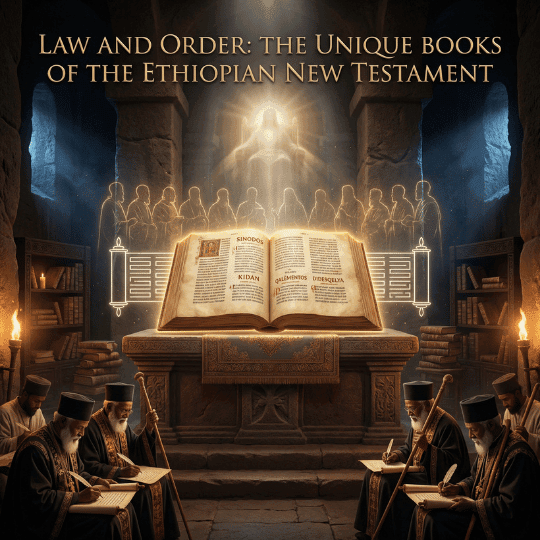
Law and Order: The Unique Books of the Ethiopian New Testament For the vast majority of Christians worldwide, the New Testament is a library of 27 books. It begins with the Gospel of Matthew and ends with the Revelation of John. This “closed list” is one of the few things that Protestants, Catholics, and Eastern Orthodox Christians agree upon. However, in the Ethiopian Orthodox Tewahedo Church (EOTC), the New Testament is not merely a collection of narratives and letters; it is a constitution. In the Broader Canon, the New Testament expands from 27 to 35 books. These eight additional books are not “gospels” or “epistles” in the traditional sense. They are books of Church Order (Ser’ate Bete Krestian). They claim to preserve the direct instructions of Christ and His Apostles regarding how the community of believers should live, worship, and govern itself. By including these legal texts directly in the biblical canon, the Ethiopian tradition refuses to separate “faith” from “polity,” or the Spirit from the Law. In this article, we will open these eight unique books—the Sinodos, the Book of the Covenant, Ethiopic Clement, and the Didascalia—to understand a vision of Christianity where the Bible is not just a book to be read, but a rule to be obeyed. Part I: The Broader Canon—Why 35 Books? As we explored in the first article, the EOTC maintains a total of 81 books. To reach this number in the “Broader Canon” (the system most often used for liturgical and theological classification), the Old Testament is counted as 46 books, allowing the New Testament to expand to 35. These 35 books consist of: The Standard 27: The Gospels, Acts, Epistles, and Revelation (just as in the West). The “Octateuch” of the New Testament: Eight books of apostolic law and order. It is important to clarify that these books are not “Gnostic” or “heretical” texts that contradict the Gospels. They are ancient compilations of canon law and community ethics, many of which were widely read in the early centuries of Christianity (3rd–5th centuries) in Syria, Egypt, and Rome, but were later separated from the Bible and placed into collections of “Canon Law” in other traditions. Ethiopia alone kept them inside the Bible. Part II: The Sinodos (The Book of the Synod) The largest block of these additional texts is the Sinodos (Ge’ez: Metsihafe Sinodos). While often bound as a single massive volume, in the canonical count it is reckoned as four distinct books. These texts are attributed to the Apostles gathered in Jerusalem (often connected to the Council of Jerusalem in Acts 15) or transmitted through Clement of Rome. 1. Ser’ate Tsion (The Order of Zion) This book contains 30 canons. It is believed to have been laid down by the Apostles in the “Upper Room” of Zion (Jerusalem). It focuses on the hierarchy of the church, establishing the distinct roles of bishops, presbyters, and deacons. It serves as the foundational “organizational chart” of the church, grounding the clergy’s authority directly in apostolic command. 2. Te’ezaz (The Commandment) Comprising 71 canons, this book delves into the moral life of the community. It offers detailed instructions on who is fit to be ordained and how the faithful should conduct themselves. It is less about administration and more about the “character” required for leadership. 3. Gitzew (Admonitions) Containing 56 canons, this text focuses on church discipline. It deals with how to treat those who have sinned, how to manage liturgical seasons, and how to handle the “marginalized” of the ancient world. 4. Abtilis This section contains 81 canons and largely parallels the “Apostolic Canons” known in other Orthodox traditions. It creates a bridge between the Ethiopian tradition and the wider Eastern Christian heritage of canon law. Collectively, the Sinodos transforms the New Testament. It implies that Jesus did not just leave his disciples with “Good News” (Gospel); He left them with a “Government.” Part III: The Book of the Covenant (Metsihafe Kidan) Perhaps the most fascinating of the additional books is the Book of the Covenant (Metsihafe Kidan), which is counted as two books (Kidan I and Kidan II). Kidan I: The Order of Worship The first book (60 sections) is primarily liturgical. It provides the rubrics for prayer, the times of service, and the administration of the sacraments. It ensures that the worship of the church is not chaotic but follows a divine pattern. Kidan II: The Testament of Our Lord The second book is of immense theological weight. Known to scholars as the Testamentum Domini, it presents itself as a discourse delivered by Jesus Christ to his disciples in Galilee after His resurrection and before His ascension. In this text, the Risen Lord speaks about the “signs of the end,” the structure of the heavenly hierarchy, and the duties of the church. For the Ethiopian believer, this gives the book a status almost higher than the Gospels. The Gospels tell us what Jesus did before death; Kidan tells us what He commanded after conquering death. It is used daily in the EOTC liturgy, specifically in the morning prayer service, cementing its practical authority. Part IV: Ethiopic Clement (Qalëmentos) The seventh book in this collection is Ethiopic Clement (Qalëmentos). Western readers might confuse this with the “Epistles of Clement” (1 & 2 Clement) found in the Apostolic Fathers. However, the Ethiopian book is a distinct, seven-part apocalyptic writing. The text is framed as a communication from the Apostle Peter to his disciple Clement (the bishop of Rome). But rather than dealing with church disputes (like the Western 1 Clement), it deals with Cosmic Secrets. It explores: The mysteries of creation. The history of the prophets. The future judgment. The interpretation of heresy and truth. Qalëmentos serves as a “hermeneutical key,” teaching the reader how to interpret history through the lens of divine providence. It reinforces the Ethiopian view that “wisdom” involves understanding the hidden structures of the universe, not just moral behavior.
6- The Mystery of Meqabyan: A Distinct Ethiopian Identity
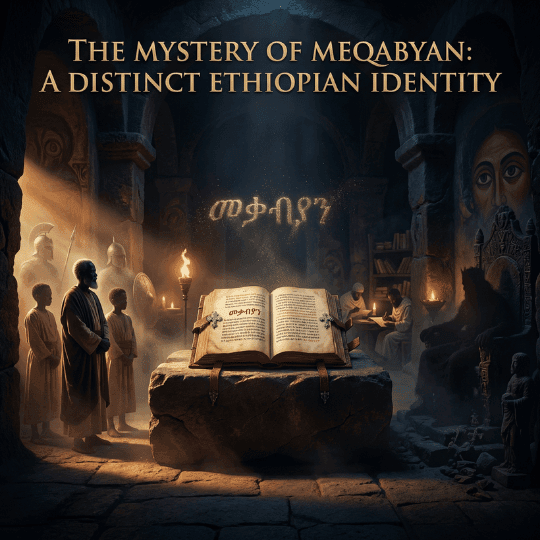
The Mystery of Meqabyan: A Distinct Ethiopian Identity Of all the surprises awaiting the scholar who opens the Ethiopian Bible for the first time, none is quite as disorienting as the encounter with the Books of Maccabees. For the Catholic or Orthodox Christian from the West, “Maccabees” conjures specific historical imagery: the Hasmonean revolt, the guerrilla warfare of Judas Maccabeus against the Seleucid Empire, the cleansing of the Temple, and the origin of the Jewish festival of Hanukkah. It is a gritty, political, and historical narrative set firmly in the 2nd century BC. However, if you open the Book of Maccabees (Meqabyan) in the Ethiopian canon, you will find none of this. There is no Judas Maccabeus hammering the Greeks. There is no Hasmonean dynasty. There is no Hanukkah. Instead, you encounter a Benjaminite named Meqabis, a tyrannical idol-worshipping king named Tsirutsaydan, and a narrative that reads more like a theological morality play than a military chronicle. This divergence is not an error; it is a profound declaration of identity. The Ethiopian Orthodox Tewahedo Church (EOTC) preserves three books—1, 2, and 3 Meqabyan—that are entirely distinct in content, origin, and theology from the four books of Maccabees found in the Greek Septuagint. In this article, we will unravel this literary mystery. We will explore the content of these unique books, investigate why they share a title with texts they do not resemble, and examine the profound theology of martyrdom and resurrection that cemented their place in the 81-book canon. Part I: The Name Enigma—Why “Maccabees”? The first question every student asks is: If these books aren’t about the historical Maccabees, why do they bear the name? To understand this, we must realize that in the early Christian world, “Maccabee” was not merely a family name (referring to the Hasmoneans); it had become a genre label. The root of the word—often associated with the Aramaic for “Hammer” or related to the concept of “fighting”—came to symbolize Martyrdom and Holy Zeal against pagan oppression. Just as modern people might use the word “Vandal” to describe anyone who destroys property (regardless of whether they belong to the ancient Germanic Vandal tribe), early Christians used “Maccabean” to describe any holy person who resisted tyranny and idolatry unto death. The Ethiopian texts are “Maccabean” in spirit, not in lineage. They narrate the struggle of the faithful against the idolatrous State. By retaining the title Meqabyan, the Ethiopian Church is asserting that these specific martyrs—Meqabis and his sons—fulfill the archetype of resistance just as well, if not better, than the historical figures of Judea. Part II: 1 Meqabyan—The Martyrdom of the Benjaminite The First Book of Ethiopian Maccabees (Meqabyan I) is a text of 36 chapters that sets the stage for the Ethiopian understanding of resistance. The Villain: Tsirutsaydan The narrative introduces a king who serves as the archetype of all pagan tyranny. His name is Tsirutsaydan. Etymologically, scholars believe this name is a Ge’ez corruption or conflation of “Tyre and Sidon” (Tsur u Tsaydan), the famous Phoenician cities often associated with Baal worship and wickedness in the Bible. In the Ethiopian imagination, Tsirutsaydan is a king of Media and Midian who is obsessed with an idol cult. The Hero: Meqabis Opposing him is not a warrior-priest like Judas, but a teacher named Meqabis. He is identified specifically as a man from the tribe of Benjamin. This tribal affiliation is significant; while the Western Maccabees were Levites (priests), the Ethiopian hero comes from the tribe of Saul and Paul, emphasizing a different kind of leadership. The core narrative follows a grim but inspiring arc: The Idol Decree: Tsirutsaydan commands his subjects to worship his idols. The Refusal: Meqabis and his sons (named Abya, Seela, Fentos, and two others) refuse. Their refusal is grounded in a sophisticated theology of the “One True God” who created heaven and earth, contrasting Him with the impotent idols of wood and stone. The Martyrdom: The king, enraged by their insolence and their teaching, orders them to be tortured and burned. They face the fire with the same stoic resolve found in the story of Shadrach, Meshach, and Abednego, or the “Woman with Seven Sons” in the Greek 2 Maccabees. The Second Group Interestingly, Chapter 15 of 1 Meqabyan introduces a second group of brothers: Yihuda (Judah), Meqabis, and Mebikyas. They lead a successful revolt against another ruthless king named Akrandis. This section bears a faint echo of the historical Judas Maccabeus, suggesting that the author of the Ethiopian text may have had access to oral traditions or fragments of the historical account, which were then woven into this new, distinct composition. However, the details remain legendary; Mebikyas is described as entering the king’s camp and decapitating him while he sat at dinner, a scene reminiscent of the Book of Judith. Part III: 2 Meqabyan—The Repentant King The Second Book of Ethiopian Maccabees (Meqabyan II) offers a surprising twist on the genre. Usually, in biblical literature, the “Enemy King” is a static figure of evil (like Pharaoh or Nebuchadnezzar). In 2 Meqabyan, the enemy becomes the hero. The book, comprising 21 chapters, begins with a figure named Meqabis—but this is not the martyr from Book 1. This Meqabis is a King of Moab. The Scourge of God Initially, this Moabite king attacks Israel. The text interprets this assault as a divine punishment for Israel’s sins. God uses the pagan king as an instrument of wrath. However, the narrative does not leave him in darkness. The Conversion Through a series of encounters and perhaps the conviction of the Holy Spirit, King Meqabis repents. He realizes the emptiness of his idols and turns to the God of Israel. He is then taught the Law of God by the prophet Rei. This is a profound theological statement. It asserts that the “Maccabean” spirit—the zeal for God’s law—is not limited to the bloodline of Israel. A Moabite king can become a “Maccabee” if he submits to the
5- Kufale: The “Little Genesis” and the Sanctity of Time
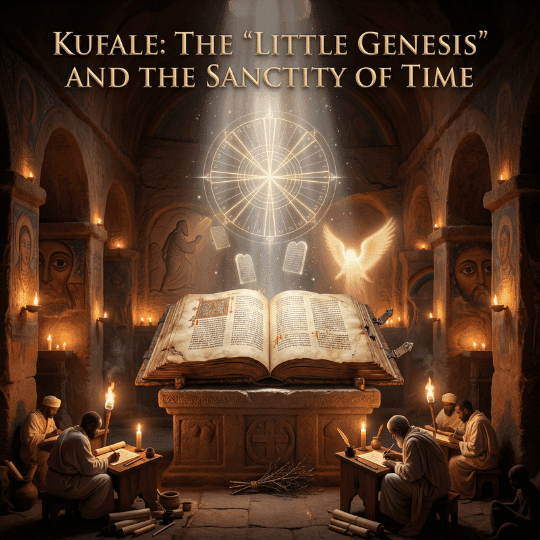
Kufale: The “Little Genesis” and the Sanctity of Time If 1 Enoch is the key to the Ethiopian understanding of the spirit world, the Book of Jubilees (Ge’ez: Metsihafe Kufale) is the key to its understanding of history, law, and time itself. To the casual observer of the Bible, the book of Genesis is a narrative of origins—a story of how the world began, how humanity fell, and how the patriarchs (Abraham, Isaac, and Jacob) walked with God before the giving of the Law. But in the Ethiopian Orthodox Tewahedo Church (EOTC), Genesis is not the only account of these events. Sitting alongside it in the canon—and often possessing a higher interpretive authority—is the Book of Jubilees. Often referred to by early Greek scholars as Leptogenesis (The “Little Genesis”) due to its specific focus on details rather than its size (it is actually quite long), Jubilees offers a retelling of the history of the world from Creation to the Exodus. However, it is not a mere repetition. It is a radical rewriting of history that claims to be the dictation of a high angel to Moses on Mount Sinai. While Western Christianity lost this book for centuries—knowing it only through scattered quotes in the Church Fathers—the Ethiopian tradition preserved it perfectly in Ge’ez. Why? Because Kufale provides the theological bedrock for the unique identity of Ethiopian Christianity. It argues that the Law of God did not begin with Moses; it is eternal, woven into the fabric of the universe, and was kept by the angels and the patriarchs long before Sinai. In this article, we will explore the “Little Genesis” that makes a massive claim: that time itself is holy, and to measure it wrongly is to step out of the rhythm of God’s creation. Part I: The Angelic Dictation on Sinai To understand the authority of Jubilees, one must understand its framing. The book opens with a specific setting: Moses is on Mount Sinai, receiving the Ten Commandments. But God does not just give him the stone tablets; He commands the Angel of the Presence to dictate the “divisions of the times” to Moses. The text reads: “And the angel of the presence who went before the camp of Israel took the tables of the divisions of the years—from the time of the creation—of the law and of the testimony of the weeks of the jubilees…” This narrative framework changes everything. In the standard Genesis account, the stories of Adam or Abraham feel like oral traditions recorded by Moses. In Jubilees, these stories are presented as contents of the Heavenly Tablets. The history of the world is not something that merely “happened”; it is something that was recorded in heaven before it occurred on earth. This concept of the “Heavenly Tablets” (Selyedat) is central to Ethiopian theology. It suggests that the history of Israel, the laws of the Torah, and the destiny of the world are pre-existent. When the Angel of the Presence dictates the history to Moses, he is revealing the cosmic blueprint. This gives the text an aura of absolute finality. It implies that the version of history found in Jubilees—with its specific dates and legal details—is the “divine draft,” of which earthly history is the enactment. Part II: The Theology of “Law Before Sinai” The most striking theological contribution of Jubilees—and the reason it feels so “at home” in the Ethiopian tradition—is its insistence on the eternity of the Law. In the Western Protestant or Catholic understanding of the Old Testament, there is a progression. Adam and Noah lived under a general covenant of conscience; Abraham lived by faith; and the specific Laws (Sabbath, Festivals, Kashrut/Dietary laws) were given specifically to Moses at Sinai hundreds of years later. Jubilees rejects this progression. It posits that the Law is eternal. It was kept by the angels in heaven before humanity was created, and it was observed by the righteous patriarchs long before Moses ascended the mountain. The Patriarchs as Torah-Keepers Jubilees rewrites the lives of the patriarchs to show them strictly observing Mosaic laws: Noah and the Feast of Weeks (Shavuot/Pentecost): In Jubilees, the covenant God makes with Noah after the Flood (the rainbow covenant) is ratified on the festival of Shavuot. Noah is described as celebrating this feast with the proper sacrifices. This links the renewal of the earth directly to the liturgical calendar. Abraham and the Feast of Booths (Sukkot): The text describes Abraham celebrating the Feast of Tabernacles (Sukkot) with joy, taking branches of palm trees and circling the altar seven times. This occurs centuries before the Levitical command to do so. The Sabbath of Creation: The book insists that the Sabbath was not an invention for the exhausted Israelites in the desert. It was kept by the “Angels of the Presence” and the “Angels of Sanctification” from the very first week of creation. God chose Israel specifically to join the angels in this observance. This theology explains the “Judeo-Christian” character of the Ethiopian Orthodox Church. Critics often ask why Ethiopian Christians practice circumcision, observe dietary laws similar to kosher, and keep the Sabbath. The answer lies in the theology of Kufale. If the Law was kept by Abraham and the angels, it is not merely a “Jewish” ceremonial law that can be discarded; it is a cosmic reality. For the Ethiopian believer, participating in these practices is not about “going back to the Old Testament”; it is about aligning with the eternal practice of the heavenly host, as revealed to the patriarchs. Part III: The Battle for Sacred Time (The Calendar) Perhaps the most practical impact of Jubilees is found in its title. Kufale means “Division” or “Distribution.” The book is obsessed with the correct division of time. In the ancient world, and in modern Judaism, the calendar is lunar (based on the moon), requiring periodic adjustments (intercalary months) to keep it aligned with the seasons. Jubilees vehemently attacks the lunar calendar as a corruption. It advocates for
4- 1 Enoch: The Apocalyptic Cornerstone of Ethiopian Theology
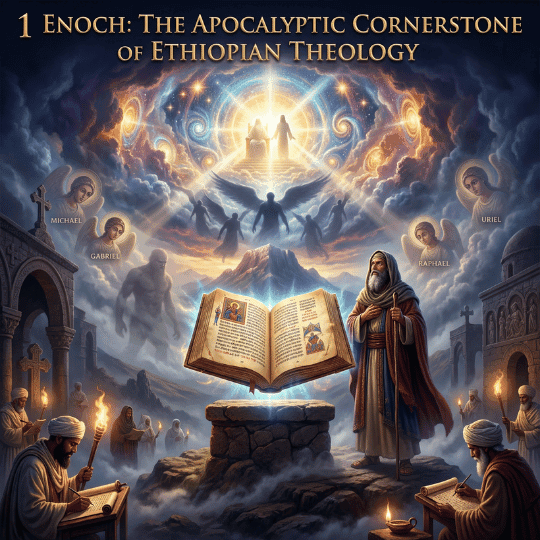
1 Enoch: The Apocalyptic Cornerstone of Ethiopian Theology In the canon of the Ethiopian Orthodox Tewahedo Church (EOTC), one book stands as a towering monolith of ancient wisdom, casting a long shadow over the theology, liturgy, and worldview of the faithful. To the Western world, it was a mystery for over a thousand years—a “lost book” referenced in the New Testament but vanished from history. To the Ethiopian believer, however, it has never been lost. It is 1 Enoch (Metsihafe Henok), a text of such cosmic scope and apocalyptic intensity that it redefines our understanding of the biblical world. While Western Christianity largely relegated Enoch to the status of “apocrypha” (hidden writings) around the 4th century AD, the Ethiopian tradition embraced it as fully canonical. Preserved in its entirety only in the ancient Ge’ez language, this book is not merely an appendix to the Ethiopian Bible; it is a cornerstone. It provides the “backstory” to Genesis, the blueprint for the New Testament’s view of the “Son of Man,” and the structural logic for the Ethiopian calendar. In this article, we will open the sealed pages of this ancient masterpiece. We will walk with Enoch through the gates of heaven, witness the rebellion of the Watchers, and stand before the Throne of Glory. We will explore why this book survived in the highlands of Africa when it perished everywhere else, and how it continues to shape the spiritual DNA of Ethiopia today. Part I: The Book That Time Forgot (and Ethiopia Remembered) The story of 1 Enoch is one of the most fascinating survival tales in literary history. Composed between the 3rd century BCE and the 1st century CE, it was originally written in Aramaic (the language of Jesus) and widely read by early Jews and Christians. The community at Qumran, who produced the Dead Sea Scrolls, treasured it; archaeologists have found numerous fragments of Enoch in their caves, proving its immense popularity in Second Temple Judaism. However, as the early Church sought to standardize its doctrine, Enoch fell out of favor in the West. Its detailed angelology, its cosmic speculations, and its use by “heretical” groups led influential figures like St. Augustine to dismiss it. By the medieval period, the text had virtually disappeared from Europe. Yet, far to the south, the Ethiopian Orthodox Church was following a different trajectory. When the “Nine Saints” arrived in Ethiopia in the 5th and 6th centuries to translate the scriptures into Ge’ez, they brought Enoch with them. They did not see it as a fringe text but as a vital piece of divine revelation. They translated it with the same reverence afforded to the Gospels or the Psalms. Because of this decision, Ethiopia became the sole custodian of the complete text. When the Scottish explorer James Bruce returned to Europe from Ethiopia in 1773 with three manuscripts of Enoch, he caused a sensation. The world suddenly realized that the “lost” words of the antediluvian patriarch had been alive and well in Africa all along. Part II: Anatomy of a Masterpiece – The Five Sections 1 Enoch is not a single book but a library of five distinct works (plus appendices), likely written by different authors over several centuries, but unified under the name of Enoch, the seventh patriarch from Adam who “walked with God” (Genesis 5:24). 1. The Book of the Watchers (Chapters 1–36) This section is perhaps the most famous and influential. It expands explosively on the brief and enigmatic account in Genesis 6:1-4, which speaks of the “sons of God” taking the “daughters of men” as wives. In the Ethiopian Bible, this is not a vague mythological reference; it is the central drama of pre-flood history. Enoch describes how 200 angels, known as the Watchers (Grigori), rebelled against God. Led by a figure named Semjaza, they descended onto Mount Hermon and swore a pact to corrupt humanity. They took human wives and birthed the Nephilim (Giants), distinct beings of immense size and voracious appetite who “devoured all the toil of men” and eventually turned on humanity itself. But the Watchers’ crime was not just physical; it was intellectual. They taught humanity forbidden arts: Azazel taught men to make swords, shields, and breastplates (introducing war). They taught women the use of antimony and makeup (introducing vanity and seduction). They revealed secrets of astrology, root-cutting (sorcery), and enchantments. This narrative provides the Ethiopian theological explanation for the origin of evil. Sin is not just a result of human weakness (as in the Adam and Eve story); it is an external infection introduced by fallen spiritual beings. Enoch acts as the intercessor, traveling between the fallen angels and the Throne of God, delivering the message of judgment: “You have no peace”. 2. The Book of Parables (Chapters 37–71) Also known as the Similitudes, this section is the theological heavyweight of the corpus. It introduces a figure of supreme importance: the Son of Man (Walda Sab). Enoch sees a vision of the “Head of Days” (God) and beside Him, the “Son of Man” who was “named before the sun and signs were created”. This figure is an eschatological judge, a pre-existent messiah who will sit on the “Throne of Glory” and judge the kings and the mighty of the earth. For the Ethiopian Church, this section is undeniably Christological. It bridges the gap between the Old Testament prophets and the Gospels. When Jesus uses the title “Son of Man” in the New Testament, he is tapping into this specific Enochic tradition. The Ethiopian scholars argue that one cannot fully understand the New Testament’s high Christology without this background. The Parables describe the Messiah not just as a suffering servant, but as a cosmic ruler existing from eternity—a view that aligns perfectly with the EOTC’s Tewahedo (unified nature) theology. 3. The Astronomical Book (Chapters 72–82) This section might seem dry to a modern reader, but it is revolutionary for the Ethiopian calendar. Uriel, the archangel of light, shows Enoch the
3- Why Ge’ez Matters: The Linguistic Guardian of Lost Scriptures
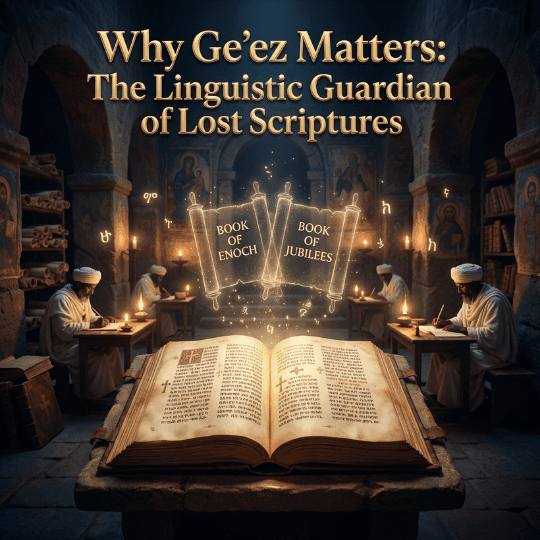
Why Ge’ez Matters: The Linguistic Guardian of Lost Scriptures In the vast landscape of biblical history, there exists a “linguistic vault”—a language that has served as a sanctuary for ancient texts that were discarded, lost, or suppressed by the rest of the world. For the Western theologian, the primary languages of scripture are Hebrew, Greek, and Latin. These are the pillars of the seminary, the tools of the exegete. Yet, there is a fourth pillar, often overlooked but structurally vital to the integrity of the ancient canon: Ge’ez (Classical Ethiopic). To understand the Ethiopian Bible, one cannot simply read it in English translation. One must understand the vessel that carried it across two millennia of isolation. Ge’ez is not merely a dialect of the Horn of Africa; it is the only language in the world that preserves the complete text of the Book of Enoch, the Book of Jubilees, and other critical works of the Second Temple period. Without Ge’ez, our understanding of the Jewish world that Jesus inhabited—and the apocalyptic theology that shaped the New Testament—would be permanently fractured. This article explores the nature of this sacred language, its pivotal role in the “Golden Age” of translation, and why modern scholars are increasingly turning to Ethiopian manuscripts to solve the riddles of biblical history. Part I: The Semitic Root and the Alphabet of Zion Ge’ez (ግዕዝ) belongs to the Semitic family of languages, placing it on the same linguistic tree as Hebrew, Aramaic, and Arabic. Specifically, it is a South Semitic language, closely related to the Sabean dialects of ancient South Arabia (modern Yemen). This linguistic genealogy is crucial because it confirms the deep, organic connection between Ethiopia and the Semitic world of the Bible. The Ethiopian claim to a “Solomonic” heritage is not just a legend found in the Kebra Nagast; it is inscribed in the very grammar of their liturgy. From Abjad to Abugida One of the most striking features of Ge’ez is its script, known as Fidel. Unlike the Hebrew or Arabic writing systems, which are “abjads” (writing mostly consonants and leaving the reader to supply the vowels), Ge’ez evolved into a syllabary (an abugida). Around the 4th century AD—coinciding roughly with the official Christianization of the Aksumite Empire under King Ezana—the script underwent a revolution. The vocalization marks were attached directly to the consonants, creating a system where every sound was written clearly. This development was not merely technical; it was theological. It allowed for the precise transmission of the Holy Scriptures. While Hebrew readers relied on oral tradition (and later the Masoretic vowel points) to know how to pronounce the sacred text, the Ethiopian scribes developed a system that locked the pronunciation into the script itself. This innovation ensured that the reading of the Bible in the Ethiopian liturgy remained stable for sixteen hundred years, preserving the “music” of the text alongside its meaning. The Death and Life of a Language Like Latin in the West, Ge’ez eventually ceased to be a spoken language for the common people, likely around the 10th to 12th centuries, being replaced by its daughter languages: Amharic, Tigrinya, and Tigre. However, it never “died” in the religious sense. It remained the living language of the liturgy (Qidase), theological debate, and royal chronicles. For the Ethiopian Orthodox Tewahedo Church (EOTC), Ge’ez is the Lesana Ge’ez—the “Tongue of the Free” or the language of the learned. It is viewed as a sacred instrument, uniquely suited for communion with God. To this day, the Debtera (the lay scholars and cantors of the church) spend decades mastering its complex grammar and vocabulary, not to speak it in the market, but to sing it in the sanctuary. This continuity means that a modern Ethiopian priest reads the same language in his Bible that the Nine Saints used in the 5th century, creating an unbroken chain of textual custody that is rare in global Christianity. Part II: The Golden Age of Translation (4th–6th Centuries) The formation of the Ethiopian Bible is inextricably linked to the “Golden Age” of Ge’ez literature. Unlike Western translations which often occurred centuries after the original composition (like the King James Version), the Ge’ez Bible was translated while the source texts were still relatively fresh and the manuscripts abundant. The Role of the “Nine Saints” While St. Frumentius (Abba Selama) initiated the translation of basic texts in the 4th century, the heavy lifting of translating the massive Ethiopian canon is attributed to the “Nine Saints” who arrived around 480 AD. These were monks fleeing the Christological controversies of the Roman/Byzantine Empire (specifically the Council of Chalcedon). Crucially, these scholars likely came from Syria. This geographical detail had a profound impact on the text. While they translated primarily from the Greek Septuagint (LXX), their background meant they were also fluent in Aramaic/Syriac. Consequently, the Ge’ez Bible is a fascinating hybrid: it is a faithful witness to the Greek Old Testament, but it is often flavored with Syriac vocabulary and syntax. This allows textual critics today to use the Ge’ez Bible to “triangulate” the original readings of the Scriptures, finding traces of early text forms that were smoothed over in later Greek or Latin revisions. A Witness to the “Old Greek” Scholars like August Dillmann and later R.H. Charles realized that the Ge’ez Old Testament often preserves an “Old Greek” text type—a version of the Septuagint that predates the standardizations made by the hexaplaric recensions (revisions by Origen and others). Why does this matter? In the transmission of ancient books, “older is better.” By translating early Greek manuscripts into Ge’ez and then locking them away in the Ethiopian highlands, the EOTC inadvertently preserved a snapshot of the Bible as it existed in the 4th and 5th centuries. In books like Kings or Jeremiah, the Ge’ez text sometimes aligns with the Dead Sea Scrolls against the standard Hebrew Masoretic Text, proving that the Ethiopian tradition preserved a legitimate, ancient Hebrew textual stream that the West had lost.